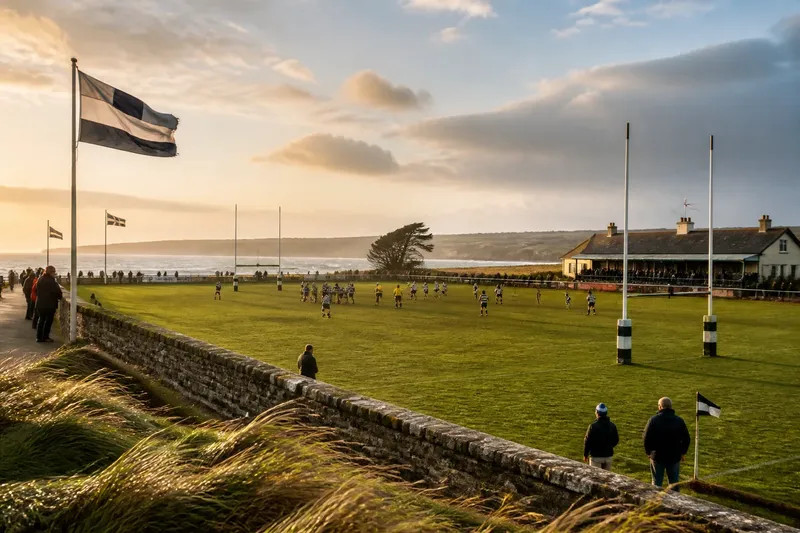
The Myth That Every Coastal Rugby Rivalry Is About Geography
Coastal rugby rivalries are not made by nearby grounds alone. Learn how shared histories and repeated encounters give local fixtures their meaning.

The most common mistake about coastal rugby rivalries is to assume that nearby clubs must dislike each other. That shortcut can make a fixture sound more intense than it is, while missing the history that actually matters to players and supporters. Coastal rugby rivalries grow from encounters, shared memories, and the meanings communities attach to them; geography may bring clubs into contact, but it cannot supply the whole story.
Two seaside grounds can sit close together and still have little sporting connection. By contrast, clubs separated by a longer journey may meet often, share a history of contested competitions, or carry memories that make each return fixture feel charged. To understand a rivalry, look beyond the map and ask what has happened between the teams, how often it has happened, and what people choose to remember.
What makes a coastal rugby rivalry more than proximity?
A rivalry is a relationship between clubs built through repeated encounters and the stories those encounters leave behind. It may involve close matches, a disputed decision, a run of meaningful fixtures, or an exchange between teams that regularly compete for the same local honor. None of these elements is essential on its own. What matters is that people on both sides recognize a particular opponent as significant.
Proximity is better understood as an opportunity than a cause. Nearby clubs may share travel routes, playing conditions, and a pool of spectators. Those common features can make meetings convenient and visible. They do not automatically create tension. If the clubs seldom play each other, or if their matches carry little consequence, the local connection may remain friendly or casual.
The distinction resembles two doors opening onto the same street: their closeness makes an encounter possible, but what happens between the people who use them gives the relationship its character. In rugby, repeated competition gives that relationship a sporting shape. A match can then become a reference point, recalled when teams meet again or when a club talks about its place in the surrounding community.
How do shared histories give fixtures meaning?
Shared history does not have to be grand or carefully recorded. It can live in a club’s memory of a difficult away trip, a season when two sides chased the same cup, or an annual fixture that brings familiar faces together. The significance often comes from accumulation: each meeting adds another detail to a story that supporters and players already know.
Those details do not need to be identical on both sides. One club may remember a close final, while the other recalls the season when a younger squad began to challenge an established opponent. This difference is part of how rivalry works. Each side interprets the shared past from its own position, and a fixture gains texture when both accounts are recognizable, even if neither is complete.
Repeated encounters also create a sense of expectation. Coaches may prepare for an opponent whose habits they know. Players may recognize individuals from previous games. Supporters may arrive with a story about the last meeting, rather than treating the match as an unfamiliar contest. Familiarity can sharpen competition, but it can also encourage respect and a social tradition that outlasts any single result.
A rivalry can change as clubs, squads, and local competitions change. A fixture that once drew strong interest may lose its edge if the teams stop meeting, while another may become important after a run of closely contested games. Clubs do not need to preserve an old label if the present relationship no longer supports it. Describing the rivalry accurately is more useful than insisting that every local fixture must be fierce.
Which kind of rivalry best describes a coastal fixture?
Three useful ways to read a rivalry are through place, repeated competition, and shared community history. These are not strict categories, and a fixture can draw on more than one. Each approach suits a different question: is the match important because the clubs belong to the same local area, because they keep meeting in consequential games, or because people have built a lasting tradition around it?
Is this mainly a neighborhood rivalry?
This approach fits clubs whose connection comes from belonging to the same coastal district or nearby settlements. It suits a fixture where local recognition, short travel, and shared community spaces matter more than a long record of consequential matches. The label should remain modest if the clubs meet only occasionally or their supporters do not treat the match as a defining occasion.
Is this a rivalry built through repeated competition?
This approach suits clubs that meet regularly in league or cup play and repeatedly have something at stake against one another. The shared record matters more than the distance between their grounds. If a fixture’s importance rises and falls with the competition, describe it in those terms rather than treating it as an ancient or permanent feud.
Does a shared community tradition sustain the rivalry?
This approach fits a fixture that gathers people through club customs, familiar social exchanges, or a recurring place in local life. It can suit teams whose sporting record is uneven, provided the match still has recognizable meaning for both communities. The tradition may center on hospitality and recognition as much as on winning.
To choose between these descriptions, start with what participants can point to: repeated meetings, a shared competition, a remembered episode, or a custom attached to matchday. Then ask whether people on both sides recognize that feature. If the strongest evidence is simply that the grounds are nearby, “local fixture” may be more precise than “rivalry.” If several features overlap, explain the combination instead of forcing the match into one box.
What should you look for beyond the map?
When judging a coastal rugby rivalry, pay attention to observable details rather than assumptions about seaside identity. A brief conversation with club members, a glance at fixture records, and attention to matchday language can help reveal what the relationship means locally. Useful clues include:
- Frequency: Do the teams meet regularly, or only when a cup draw brings them together?
- Consequence: Have recent meetings affected a shared competition, or carried a specific sporting challenge?
- Memory: Can people recall particular encounters that still shape how they talk about the fixture?
- Recognition: Do players and supporters on both sides identify the opponent as significant?
- Tradition: Are there recurring customs, familiar exchanges, or community gatherings linked to the match?
- Change: Does the relationship still feel active, or does its importance rest mostly on an older story?
These clues can point in different directions. A fixture may be frequent but not especially consequential, or rarely played yet strongly remembered. Rather than treating one sign as proof, explain which features are present and what they suggest. That approach gives readers a clearer sense of why a match matters without inflating ordinary competition into a feud.
How can clubs describe a rivalry without forcing the story?
Clubs can start with precise language. “A nearby league opponent,” “a recurring cup matchup,” and “a traditional local fixture” each describe a different relationship. Calling every nearby opponent a rival can flatten those distinctions and imply hostility where none exists. A careful description leaves room for competitive intensity, friendship, and change.
It also helps to ask how both clubs tell the story. A club newsletter might focus on a memorable contest, while a visiting side emphasizes the welcome it receives or the challenge of playing a familiar opponent. Neither account needs to be treated as the single official version. A rivalry often becomes more legible when its different memories sit alongside each other.
Say two seaside clubs share a boundary road but rarely meet, while a third club farther along the coast has faced one of them repeatedly in a local cup. If supporters recall those cup encounters and players prepare specifically for that opponent, the farther club may be the more meaningful rival. The expected observable result of describing the fixtures this way is simple: readers can tell which connection comes from location and which has been shaped by competition.
Coastal rugby rivalries are best understood as relationships with a history, not as automatic products of a map. Geography can put clubs within reach of one another, but encounters and shared memory give a fixture its particular character. When explaining a coastal rugby rivalry, name the evidence people recognize and leave room for the relationship to change; that is more revealing than assuming every neighboring club is a natural enemy.