Why the Wind Changes the Shape of a Rugby Ground
Learn how wind changes the way a coastal rugby ground feels, so you can read its orientation, exposed edges, shelter and shifting view from the touchline.
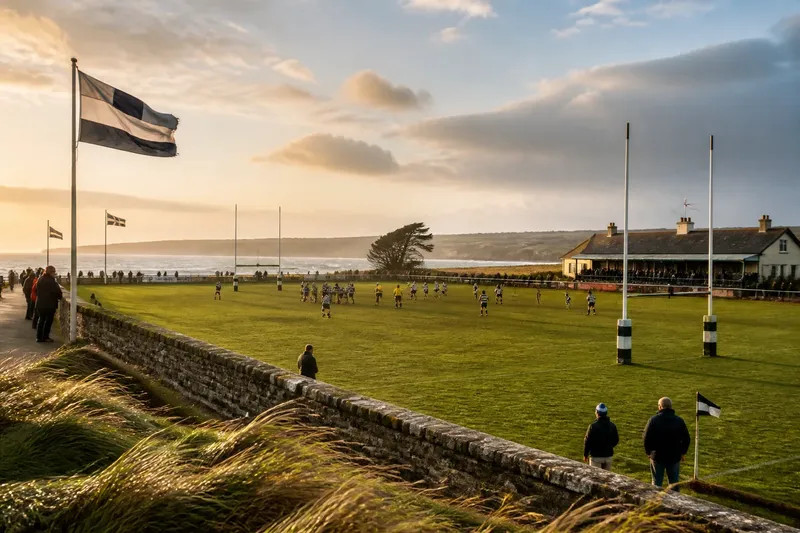
The common mistake at a coastal rugby ground is to blame the view when the wind is really changing what the view feels like. A rugby ground’s orientation, open edges and nearby shelter can make the same pitch seem broad, narrow, close or oddly tilted from one place to another. Reading those clues helps explain the setting without turning a visit into a lesson in how to play.
Why does the pitch seem to lean?
On an exposed site, wind can arrive across the pitch, along its length or at an angle. The direction may be easiest to notice in flags, tree branches, smoke from a nearby chimney, or the movement of loose grass and leaves. These cues can make a pitch feel as though one end is more exposed or more prominent, even though its boundaries are fixed.
Start by separating the ground’s physical alignment from the impression created by weather. Look for the touchlines, goalposts and any fixed features such as a clubhouse, road or sea wall. Then notice which way the flags or branches move. If they point across the field while the goalposts line up in the same direction, the pitch has not changed shape; the moving air is simply crossing the view.
A useful everyday comparison is a window in a drafty room: the room stays put, but the current of air makes one side feel more exposed. At a rugby ground, wind can give a near touchline a stronger presence or make the far end feel distant. That sensation may shift during a match as gusts ease or change direction.
Why does one side feel more open?
Coastal grounds often sit beside open land, a promenade, a road, dunes or a water-facing edge. The side with fewer buildings, trees or banks usually offers fewer visual interruptions. If wind approaches from that direction, the openness can register both as a broad view and as a sense of exposure.
Look beyond the playing enclosure. A line of houses may shelter one touchline, while the opposite side looks directly toward a bay or an open stretch of grass. A clubhouse can also interrupt the view without making the ground itself feel enclosed. These features explain why two seats at the same match can give very different impressions of the pitch.
If a side seems unusually wide, check whether you are comparing a clear horizon with a cluttered background. A far touchline backed by open sky can be harder to judge than one backed by buildings or trees. The pitch may look larger because its edge has fewer landmarks to help the eye place it.
What makes the corners feel exposed?
Wind does not meet every part of a ground evenly. Buildings, hedges, raised banks and gaps between structures can redirect moving air. One corner may feel still while another catches a gust, even when both sit only a short distance apart.
Look for changes in shelter rather than assuming that the whole ground faces the wind in one uniform way. A low wall may block air near the ground but leave flags above it moving. A stand may shelter its own seating while leaving the touchline beside it open. These small contrasts help explain why the wind seems to come from different directions as you move around the perimeter.
For a clear reading, compare fixed signs or flags at more than one edge. If they move differently, nearby structures may be channeling or disturbing the airflow. The point is not to map every gust, but to see how the ground’s built and natural edges shape what a spectator notices.
Why does the far touchline seem to disappear?
On a bright, windy day, the far side can seem less distinct when open sky, pale sand, water or low vegetation blends into the background. Moving flags and branches add visual activity, drawing attention away from the boundary. The result can be a pitch that feels less clearly framed, even when its lines and posts are easy to identify up close.
Try locating a fixed landmark behind each end or side: a stand roof, a church tower, a row of houses or a distinctive section of sea wall. Then compare the boundary with that landmark rather than judging the distance by empty sky alone. This gives the eye a stable reference while the weather and surrounding foliage move.
Imagine arriving at a ground where one touchline faces a low promenade wall and the opposite side opens toward the water. If the wind is moving the flags above the open side, begin by spotting the goalposts and a fixed building beyond the sheltered touchline. The expected result is a clearer sense of the pitch’s actual alignment, even if the open side still feels broader and less defined.
How can you read a coastal rugby ground’s orientation?
Orientation means the direction the pitch runs across the site. It is a fixed feature, unlike the wind, which can change over the course of a match. To read the setting, use several clues together:
- Find the goalposts. Their line shows the pitch’s long axis more reliably than a windblown flag.
- Compare the touchlines. Note which one faces open land or water and which one has buildings, trees or a bank nearby.
- Check fixed landmarks. A clubhouse, stand or sea wall can help you judge whether a view is broad because of the pitch or because its background is open.
- Watch more than one flag. Different movement around the ground can point to local shelter or channeling rather than a single, steady direction.
- Notice the sightline from your seat. A roof edge, fence or stand column can frame the pitch and make one side seem closer.
- Separate motion from structure. Trees and flags move; posts, lines and buildings do not.
These observations work best as a comparison, not as a search for one perfect viewpoint. A seat behind the posts emphasizes the length of the field; a place beside the touchline emphasizes its width. Add an open horizon or a sheltered stand, and the same ground can seem to have a different shape.
What should you look for when the wind shifts?
A changing wind can make earlier impressions unreliable. A flag that hung toward one corner may lift or turn, while branches on the other side respond differently. Rather than treating the first direction you noticed as the setting’s permanent character, check the visible cues again from where you are standing.
Three questions can make that check more useful:
Which landmarks stay still?
Use goalposts, building edges and pitch markings to establish the ground’s fixed lines. They provide a stable reference when flags or leaves move.
Does the open side feel different from the sheltered side?
Compare the views and nearby barriers. An exposed edge may make the pitch feel broader, while a stand or hedge can give the opposite side a more contained appearance.
Are different corners showing different wind cues?
Look across the perimeter before deciding that the entire ground is affected in one way. A stand, wall or gap between buildings can change what the wind does locally.
Has the view changed, or only the weather?
Recheck the fixed boundaries before concluding that the pitch seems narrower or more angled. If the lines and posts remain in place, the shift is in the conditions or your visual frame, not in the ground itself.
What if the ground still feels oddly shaped?
Some grounds really do have irregular surroundings. A curved road, a sloping bank, a narrow stand or a boundary that meets older buildings can make the enclosure feel asymmetrical. Wind may heighten that impression, but it is not the only explanation. Look for the actual edge of the playing area and distinguish it from fences, seating and paths beyond it.
Also notice where you are standing. A view from low beside the touchline can make the opposite side feel farther away than a view from a raised stand. A roof, glass panel or fence can frame the field, while the open side appears to spill into its surroundings. Those effects belong to the spectator’s position as much as to the coastal setting.
When you want to understand a rugby ground’s orientation, begin with the fixed lines, then read the wind through flags, vegetation and shelter. That simple order keeps the setting legible: the pitch supplies the frame, while the coast and weather explain why the frame can feel different from one edge to the next.